
Traits Of Fantasy-
The identifying traits of fantasy are the inclusion of fantastic elements in a self-coherent (internally consistent) setting, where inspiration from mythology and folklore remains a consistent theme. Within such a structure, any location of the fantastical element is possible: it may be hidden in, or leak into the apparently real world setting, it may draw the characters into a world with such elements, or it may occur entirely in a fantasy world setting, where such elements are part of the world. Essentially, fantasy follows rules of its own making, allowing magic and other fantastic devices to be used and still be internally cohesive.

Its History
Beginning perhaps with the Epic of Gilgamesh and the earliest written documents known to humankind, mythic and other elements that would eventually come to define fantasy and its various subgenres have been a part of some of the grandest and most celebrated works of literature. From The Odyssey to Beowulf, from the Mahabharata to The Book of One Thousand and One Nights, from the Ramayana to the Journey to the West, and from the Arthurian legend and medieval romance to the epic poetry of the Divine Comedy, fantastical adventures featuring brave heroes and heroines, deadly monsters, and secret arcane realms have inspired many audiences. In this sense, the history of fantasy and the history of literature are inextricably intertwined.
There are many works where the boundary between fantasy and other works is not clear; the question of whether the writers believed in the possibilities of the marvels in A Midsummer Night's Dream or Sir Gawain and the Green Knight makes it difficult to distinguish when fantasy, in its modern sense, first began.
Although pre-dated by John Ruskin's The King of the Golden River (1841), the history of modern fantasy literature is usually said to begin with George MacDonald, the Scottish author of such novels as The Princess and the Goblin and Phantastes (1858), the latter of which is widely considered to be the first fantasy novel ever written for adults. MacDonald was a major influence on both J. R. R. Tolkien and C. S. Lewis. The other major fantasy author of this era was William Morris, a popular English poet who wrote several novels in the latter part of the century, including The Well at the World's End.
Despite MacDonald's future influence with At the Back of the North Wind (1871), Morris's popularity with his contemporaries, and H.G. Wells's The Wonderful Visit (1895), it wasn't until the 20th century that fantasy fiction began to reach a large audience. Lord Dunsanyestablished the genre's popularity in both the novel and the short story form. Many popular mainstream authors also began to write fantasy at this time, including H. Rider Haggard, Rudyard Kipling and Edgar Rice Burroughs. These authors, along with Abraham Merritt, established what was known as the "lost world" sub-genre, which was the most popular form of fantasy in the early decades of the 20th century, although several classic children's fantasies, such as Peter Pan and The Wonderful Wizard of Oz, were also published around this time.
Indeed, juvenile fantasy was considered more acceptable than fantasy intended for adults, with the effect that writers who wished to write fantasy had to fit their work in a work for children. Nathaniel Hawthorne wrote fantasy in A Wonder-Book for Girls and Boys, intended for children, though works for adults only verged on fantasy. For many years, this and successes such as Alice's Adventures in Wonderland (1865), created the circular effect that all fantasy works, even the later The Lord of the Rings, were therefore classified as children's literature.
In 1923, the first all-fantasy fiction magazine, Weird Tales, was created. Many other similar magazines eventually followed, most noticeably The Magazine of Fantasy and Science Fiction. The pulp magazine format was at the height of its popularity at this time and was instrumental in bringing fantasy fiction to a wide audience in both the U.S. and Britain. Such magazines were also instrumental in the rise of science fiction, and it was at this time the two genres began to be associated with each other.
By 1950, "sword and sorcery" fiction had begun to find a wide audience, with the success of Robert E. Howard's Conan the Barbarian and Fritz Leiber's Fafhrd and the Gray Mouser stories. However, it was the advent of high fantasy, and most of all J. R. R. Tolkien'sThe Hobbit and The Lord of the Rings which reached new heights of popularity in the late 1960s, that allowed fantasy to truly enter the mainstream. Several other series, such as C. S. Lewis's Chronicles of Narnia and Ursula K. Le Guin's Earthsea books, helped cement the genre's popularity.
The popularity of the fantasy genre has continued to increase in the 21st century, as evidenced by the best-selling statuses of J. K. Rowling's Harry Potter series; Rick Riordan's Percy Jackson & the Olympians pentalogy, which focuses on Greek mythology; The Kane Chronicles trilogy, which focuses on Egyptian mythology; and the Heroes of Olympus trilogy, which focuses on Greek and Roman mythology, along with all three's successors. Several fantasy film adaptations have achieved blockbuster status, most notablyThe Lord of the Rings film trilogy directed by Peter Jackson, and the Harry Potter films, currently one of the highest-grossing film series in film history.
Media-
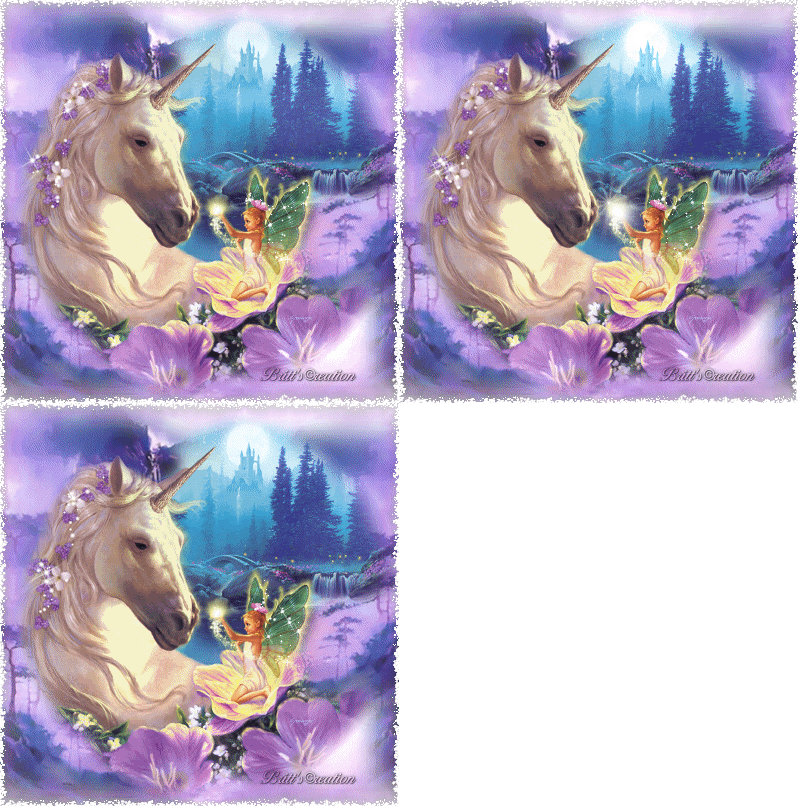
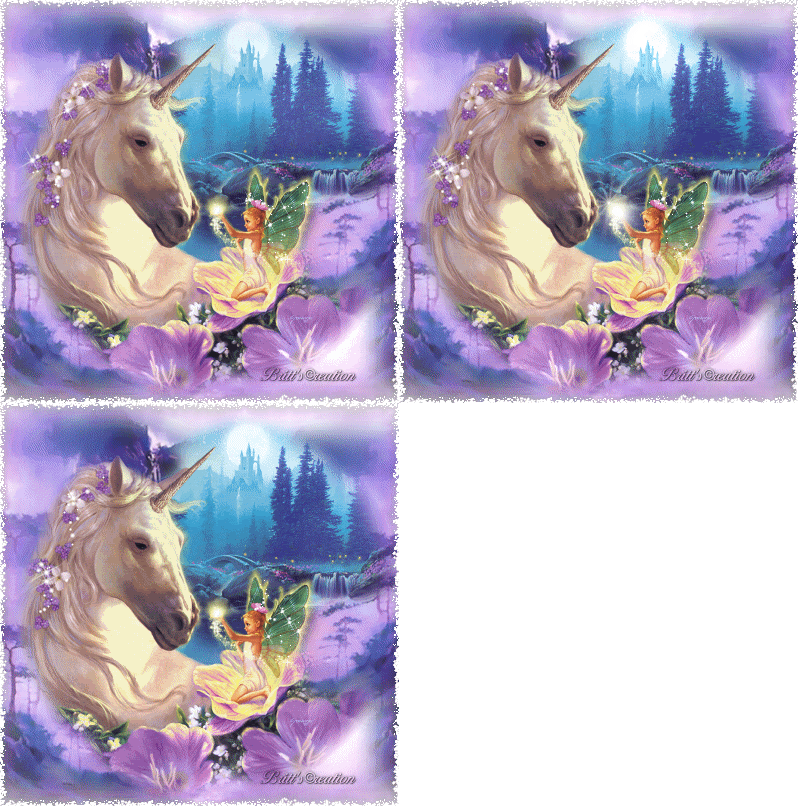
Fantasy is a popular genre, having found a home for itself in almost every medium. While fantasy art and recently fantasy films have been increasingly popular, it is fantasy literature which has always been the genre's primary medium.
Fantasy role-playing games cross several different media. Dungeons & Dragons was the first tabletop role-playing game, and remains the most successful and influential. The science fantasy role-playing game series Final Fantasy has been an icon of the role-playing video game genre (as of 2012 still among the top ten best-selling video game franchises). The first collectible card game, Magic: The Gathering, has a fantasy theme, and is similarly dominant in the industry.


Subgenres & subcultures-
Modern fantasy, including early modern fantasy, has also spawned many new subgenres with no clear counterpart in mythology or folklore, although inspiration from mythology and folklore remains a consistent theme. Fantasy subgenres are numerous and diverse, frequently overlapping with other forms of speculative fiction in almost every medium in which they are produced. A couple of examples are the science fantasy and dark fantasy subgenres, which the fantasy genre shares with science fiction and horror, respectively.
Professionals such as publishers, editors, authors, artists, and scholars within the fantasy genre get together yearly at the World Fantasy Convention. The World Fantasy Awards are presented at the convention. The first WFC was held in 1975, and it has occurred every year since. The convention is held at a different city each year.
Additionally, many science fiction conventions, such as Florida's FX Show and MegaCon, cater to fantasy and horror fans. Anime conventions, such as Ohayocon or Anime Expo frequently feature showings of fantasy, science fantasy, and dark fantasy series and films, such as Majutsushi Orphen (fantasy), Sailor Moon (urban fantasy), Berserk (dark fantasy), and Spirited Away (fantasy). Many science fiction/fantasy and anime conventions also strongly feature or cater to one or more of the several subcultures within the main subcultures, including the cosplay subculture (in which people make and/or wear costumes based on existing or self-created characters, sometimes also acting out skits or plays as well), the fan fiction subculture, and the fan video or AMV subculture, as well as the large internet subculture devoted to reading and writing prose fiction and/or doujinshi in or related to those genres.

Conscious fantasy-
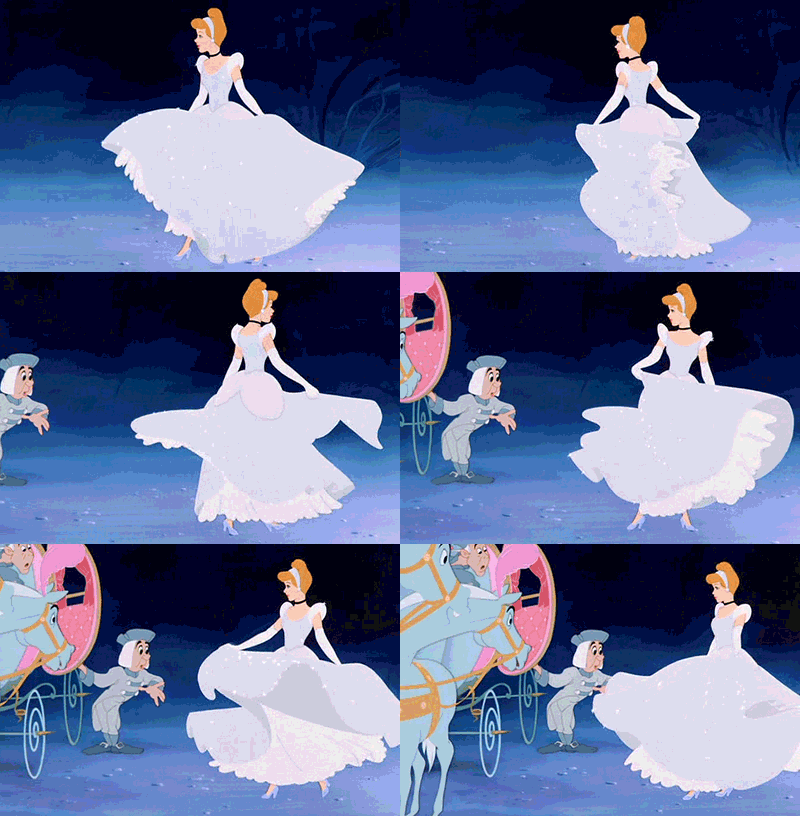
A fantasy is a situation imagined by an individual that expresses certain desires or aims on the part of its creator. Fantasies sometimes involve situations that are highly unlikely; or they may be quite realistic. Fantasies can also be sexual in nature. Another, more basic meaning of fantasy is something which is not 'real,' as in perceived explicitly by any of the senses, but exists as an imagined situation of object to subject.
In everyday life, individuals often find their thoughts pursue a series of fantasies concerning things they wish they could do or wish they had done...fantasies of control or of sovereign choice...daydreams'.
Vaillant in his study of defence mechanisms took as a central example of 'an immature defence...fantasy - living in a "Walter Mitty" dream world where you imagine you are successful and popular, instead of making real efforts to make friends and succeed at a job'. Fantasy, when pushed to the extreme, is a common trait of narcissistic personality disorder; and certainly 'Vaillant found that not one person who used fantasy a lot had any close friends'.
Other researchers and theorists find that fantasy has beneficial elements — providing 'small regressions and compensatory wish fulfilments which are recuperative in effect'. Research by Deirdre Barrett reports that people differ radically in the vividness, as well as frequency of fantasy, and that those who have the most elaborately developed fantasy life are often the people who make productive use of their imaginations in art, literature, or by being especially creative and innovative in more traditional professions.
Unconscious fantasy-
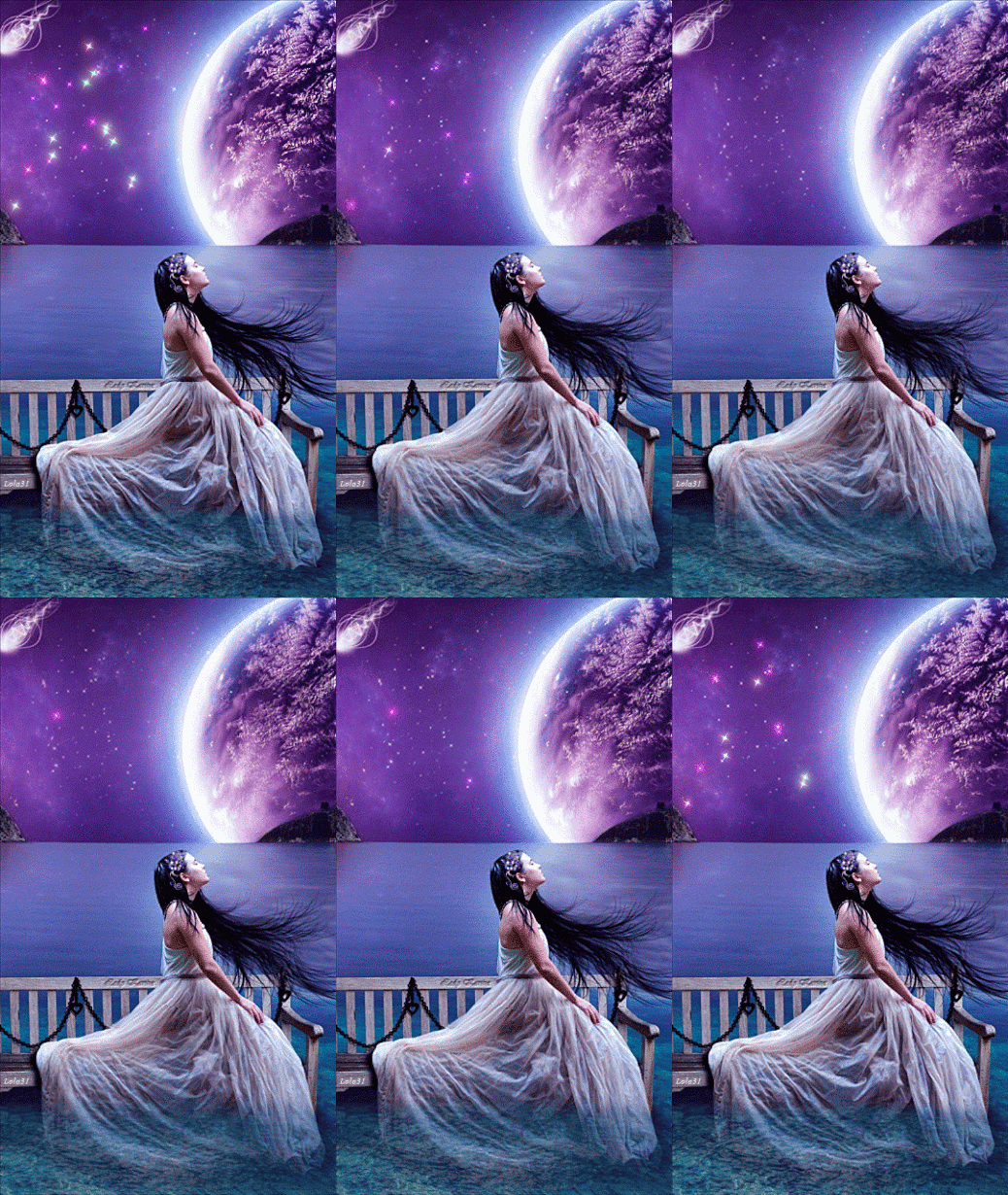
Melanie Klein extended Freud's concept of fantasy to cover the developing child's relationship to a world of internal objects. In her thought, this kind of 'play activity inside the person is known as "unconscious fantasy". And these phantasies are often very violent and aggressive. They are different from ordinary day-dreams or "fantasies" (spelled with an "f")'.
The term "fantasy" became a central issue with the development of the Kleinian group as a distinctive strand within the British Psycho-Analytical Society, and was at the heart of the so-called Controversial discussions of the wartime years. 'A paper by Susan Isaacs (1952) on "The nature and function of Phantasy"...has been generally accepted by the Klein group in London as a fundamental statement of their position'. As a defining feature, 'Kleinian psychoanalysts regard the unconscious as made up of phantasies of relations with objects. These are thought of as primary and innate, and as the mental representations of instincts...the psychological equivalents in the mind of defence mechanisms'.
Isaacs considered that 'Unconscious phantasies exert a continuous influence throughout life, both in normal and neurotic people, the difference lying in the specific character of the dominant phantasies'; Most schools of psychoanalytic thought would now accept that 'Both in analysis and life, we perceive reality through a veil of unconscious fantasy'. Isaacs however claimed that 'Freud's "hallucinatory wish-fulfilment" and his.."introjection" and "projection" are the basis of the fantasy life'; and how far unconscious fantasy was a genuine development of Freud's ideas, how far it represented the formation of a new psychoanalytic paradigm, is perhaps the key question of the Controversial discussions.
Freud & Daydreams-
A similarly positive view of fantasy was taken by Sigmund Freud who considered fantasy a defence mechanism. He considered that men and women "cannot subsist on the scanty satisfaction which they can extort from reality. 'We simply cannot do without auxiliary constructions,' as Theodor Fontane once said ... [without] dwelling on imaginary wish fulfillments." As childhood adaptation to the reality principle developed, so too 'one species of thought activity was split off; it was kept free from reality-testing and remained subordinated to the pleasure principle alone. This activity isfantasying...continued as day-dreaming. He compared such phantasising to the way a 'nature reserve preserves its original state where everything...including what is useless and even what is noxious, can grow and proliferate there as it pleases'.
Daydreams for Freud were thus a valuable resource. "These day-dreams are cathected with a large amount of interest; they are carefully cherished by the subject and usually concealed with a great deal of sensitivity ... such phantasies may be unconscious just as well as conscious." He considered "These phantasies include a great deal of the true constitutional essence of the subject's personality" and that the energetic man "is one who succeeds by his efforts in turning his wishful phantasies into reality," whereas the artist "can transform his phantasies into artistic creations instead of into symptoms ... the doom of neurosis."

